.png)

Change how your organization decides what to build, how to build it, and what to learn from the work.
Vector North helps product organizations modernize the operating model behind product decisions, opportunity prioritization, team structure, AI adoption, and continuous learning. The goal is not change for its own sake. The goal is an organization that makes better product decisions and adapts faster as new evidence emerges.
When the operating model stops keeping up.
Most organizations do not wake up one morning and decide they need to change how they work. They reach a point where the way they have always operated is no longer producing the results they expect. Priorities compete for attention. Roadmaps become harder to trust. AI ideas multiply without creating measurable value. Teams stay busy while leadership grows less confident that the organization is building the right things.
- Roadmaps receive more attention than outcomes.
- AI opportunities appear faster than leadership can evaluate them.
- Teams optimize locally instead of organizationally.
- Governance slows decisions but does not improve them.
- Product decisions depend more on hierarchy than evidence.
- Good people are compensating for weak systems through individual heroics.
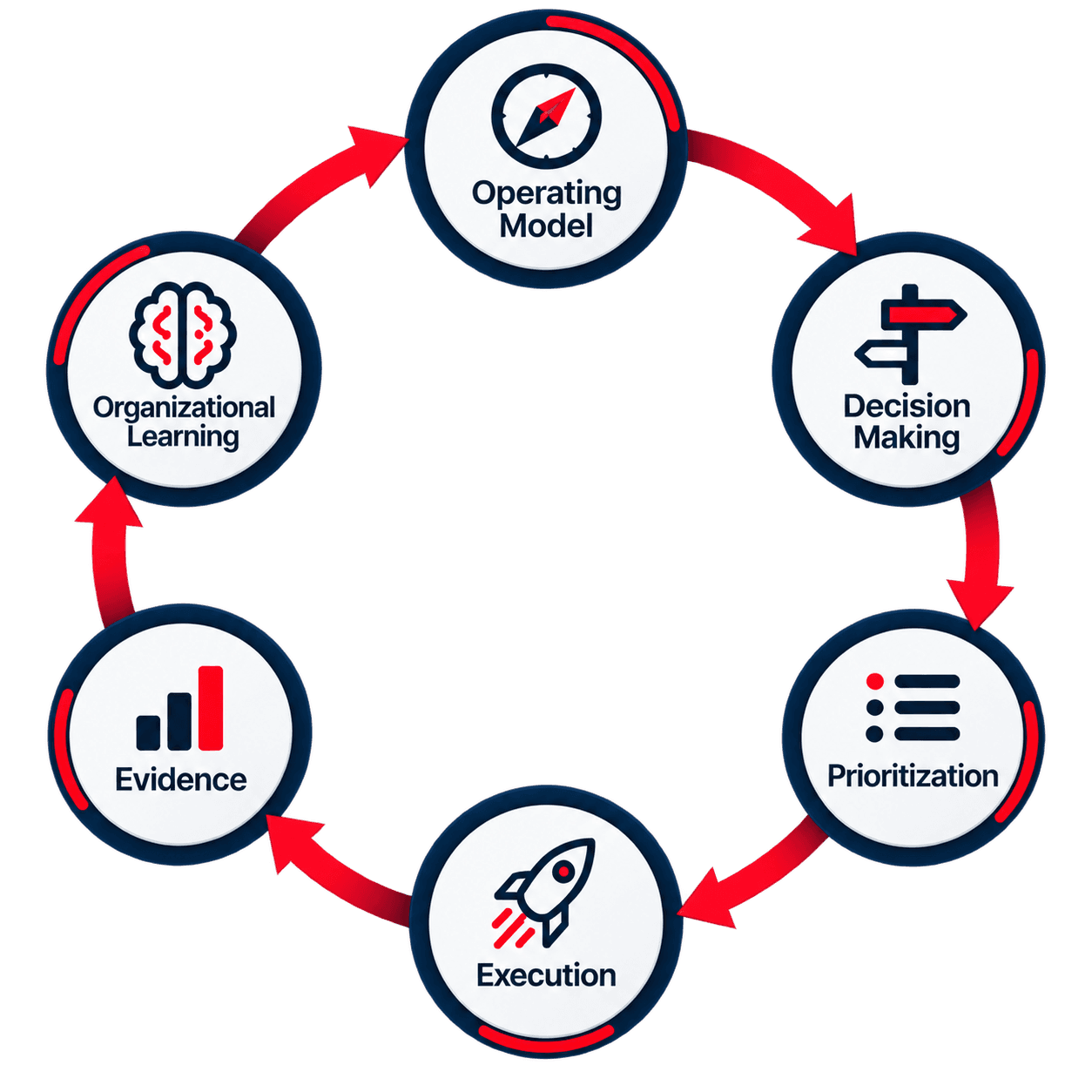
The operating model becomes continuous.
Decision making shapes prioritization. Prioritization shapes execution. Execution produces evidence. Evidence becomes organizational learning. What the organization learns then reshapes how it decides, and the cycle continues.
What changes.
Before
Planning dominates learning.
After
Learning influences planning.
Before
Roadmaps resist evidence.
After
Evidence legitimately changes priorities.
Before
AI initiatives compete for attention based on enthusiasm.
After
AI investments follow a consistent decision model.
Before
Teams optimize within functional boundaries.
After
Cross-functional teams align around shared outcomes.
Before
Success is measured primarily by delivery.
After
Success is measured by outcomes and what the organization learns.
Before
Learning remains local to individual teams.
After
Learning is captured and reused across the organization.
Transformation is not another layer of process.
- Reorganizing for the sake of reorganizing
- Buying AI tools and calling it transformation
- Adding more governance
- Replacing one rigid methodology with another
- Producing a strategy deck that never changes the work
- Introducing new terminology without changing decisions
Real transformation changes how the organization identifies opportunities, makes decisions, forms teams, evaluates evidence, allocates investment, and learns from products and customers.
AI changes more than the tools. It changes the economics of learning.
Most conversations about AI in product organizations focus on faster coding, automation, and efficiency. Those gains are real, but they are not the most important shift. The deeper change is that AI reduces the cost of exploring ideas and gathering evidence: prototypes take days instead of weeks, feedback gets synthesized faster, and more solution paths can be explored before committing to one.
When learning becomes cheaper, the old response is to use AI to accelerate the existing process. The more useful response is to rethink how the process itself works, because a process built for a world where exploration was expensive no longer fits one where it is not.
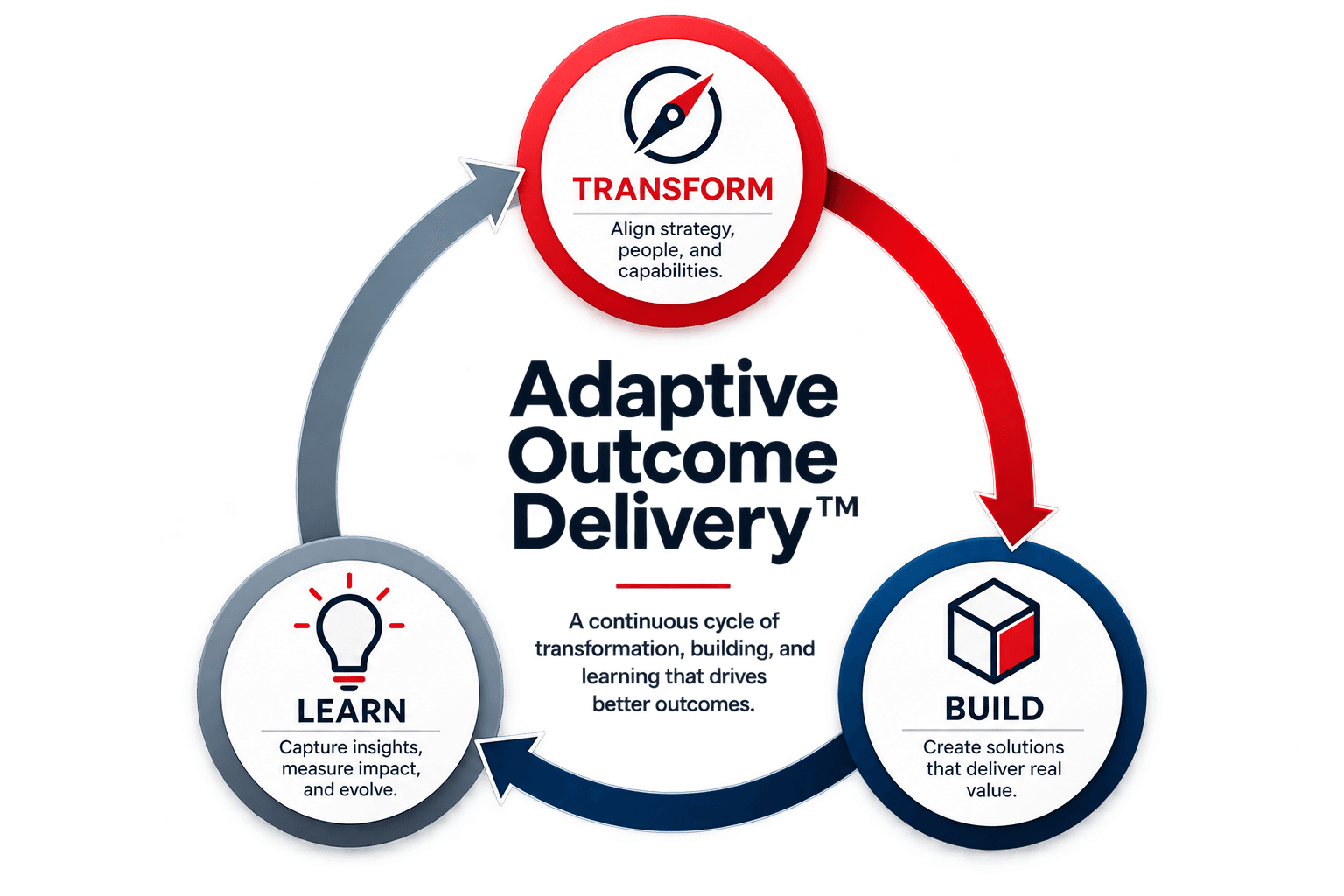
Adaptive Outcome Delivery™
Adaptive Outcome Delivery is built on the belief that organizations create lasting advantage by learning faster, not simply by delivering more. It connects strategy, product building, evidence, and organizational learning so that each initiative improves both the product and the organization's ability to make the next decision. It connects Build and Learn into the same operating cycle as Transform.
- Uses outcomes, not output, to guide the work
- Treats roadmaps as hypotheses rather than immutable commitments
- Lets evidence influence decisions, not just justify them afterward
- Supports cross-functional collaboration by design
- Builds learning into the operating cycle itself
- Helps organizations adapt as new information emerges
What a Transform engagement can look like.
The specifics vary by organization, but the shape of the work is consistent.
- 1Understand how the organization currently makes product decisions, and where friction and conflicting incentives slow it down
- 2Clarify the business and customer outcomes that matter most
- 3Evaluate how opportunities are prioritized, and where AI can improve the product or the process of building it
- 4Design practical changes to how the organization works
- 5Implement those changes alongside the team
- 6Measure what is changing and what still needs attention
Some organizations engage Vector North to guide a focused transformation initiative. Others need experienced product leadership embedded in the organization while the change is underway. Product Leadership can provide continuity and ownership while new operating practices are being introduced.
Questions worth asking.
- 01
Are we building the right things, or simply delivering what was already planned?
- 02
Do we know why our highest-priority initiatives deserve investment?
- 03
Can new customer or product evidence legitimately change our priorities?
- 04
Are our AI investments creating measurable customer or business value?
- 05
Does every product initiative leave the organization smarter than it was before?
What success should look like.
- Leadership has greater confidence in what should be built next.
- Product and engineering are working from the same priorities.
- AI opportunities are evaluated consistently rather than pursued opportunistically.
- New evidence can influence investment without creating chaos.
- Product work generates reusable organizational learning.
- Governance becomes lighter while decision quality improves.
- The organization is better equipped to continue evolving without outside dependency.
Transformation creates the conditions. Building puts them into contact with reality.
Changing how an organization decides and prioritizes is only valuable if those decisions lead to meaningful action. Build turns the most important opportunities into something real enough to test, use, and learn from.
Explore BuildTransformation is not the goal.
The goal is an organization that consistently makes better product decisions, learns faster, and adapts before outdated assumptions become expensive commitments. If the way your organization builds products no longer matches the environment in which it operates, the answer may not be another tool or another framework. It may be time to change the operating model itself.